A Pilot Çalışma: An İnovatif Son-effector Haptic Cihaz Applied in Subacute and Chronic Inme Hastalar - Inme Merkez
Giriş
Inme is currently the leading Neden of long-term disability and is often associated with functional impairment of the üst ekstremites, which is generally more common than that of the alt ekstremites. Motor dysfunction of the üst ekstremites is often associated with other Nörolojik symptoms that hinder the Kurtarma of motor function and therefore requires systematic and Profesyonel therapeutic intervention.
The main Hedef of inme rehabilitasyonu is to promote fonksiyonel iyileşme of the damaged limb to maximize functional Sonuçlar and improve Kalite of life. Çalışmalar have shown that providing high-inTENSity Terapi and task-specific Egzersiz Eğitim combined with Robotik and traditional rehabilitasyon Programlar can achieve Daha iyi Sonuçlar. Recent Çalışmalar have shown that the Kullanım of robotics in rehabilitasyon Terapi is Kuyu-accepted and Kuyu-tolerated in Hastalar with chronic inme. The Mevcut Analiz of the Mekanizm of motor iyileşme in inme Hastalar is only Temelli Açık Klinik Sonuç measures, while the Robotik Sistem can provide Farklı biomechanical Veri Kayıtlar, such as Hız, Güç, etc., which can be used to Analiz etmek and evaluate the Kurtarma of inme Hastalar.
The main Amaç of this Çalışma is to evaluate the effects of üst ekstremite Robot-assisted rehabilitasyon Açık motor iyileşme in inme Hastalar who underwent Tedavi Temelli Açık a haptic Cihaz.
Methods
A Toplam of 39 inme Hastalar (23 subacute and 16 chronic) underwent rehabilitasyon Eğitim by using the novel Son-traction üst ekstremite rehabilitasyon robotu. For Karşılaştırma, 13 healthy subjects were recruited.
The following Klinik Sonuç measures were used: Chedoke-McMaster Inme Değerlendirme (CMSA), Modified Ashworth Ölçek (Modified Ashworth Ölçek, modified Ashworth Ölçek), and Modified Ashworth Ölçek (Modified Ashworth Ölçek, modified Ashworth Ölçek) were used to evaluate inme severity. MAS), Fugl-Meyer Değerlendirme Upper Extremity Ölçek (FMA-UE), Tıbbi Araştırma Council (MRC) Yöntem, Tıbbi Araştırma Council (MRC) Yöntem, Fugl-Meyer Değerlendirme Upper Extremity Ölçek (FMA-UE). MRC), Motricity Dizin (MI), Kutu and Block Test (B&B) and modified Barthel Dizin (MBI).
The following Parametreler were calculated: mean Hız, Maksimum Hız, meantime, path Uzunluk, standardized jitter, mean Kuvvet, mean Hata, mean Enerji expenditure, and Yüzde of Aktif Hasta-Robot interactions. Assessments were performed before and after Tedavi.
Sonuçlar
In Table 3, thirty-nine inme Hastalar (twenty-three subacute and sixteen chronic) underwent rehabilitasyon Eğitim by using MOTORE/Armotion haptic Sistem. Thirteen healthy subjects were recruited for Karşılaştırma purposes. The following Klinik Sonuç measures were used: Chedoke-McMaster Inme Değerlendirme, Modified Ashworth Ölçek (MAS), Fugl-Meyer Değerlendirme (FM), Tıbbi Araştırma Council, Motricity Dizin (MI), Kutu and Block Test (B&B) and Modified Barthel Dizin (mBI). The following Parametreler were computed: mean Hız, Maksimum Hız, meantime, path Uzunluk, normalized jerk, mean Kuvvet, mean Hata, mean Enerji expenditure and Aktif Hasta-Robot interaction Yüzde. The assessments were carried-out before and after Tedavi.
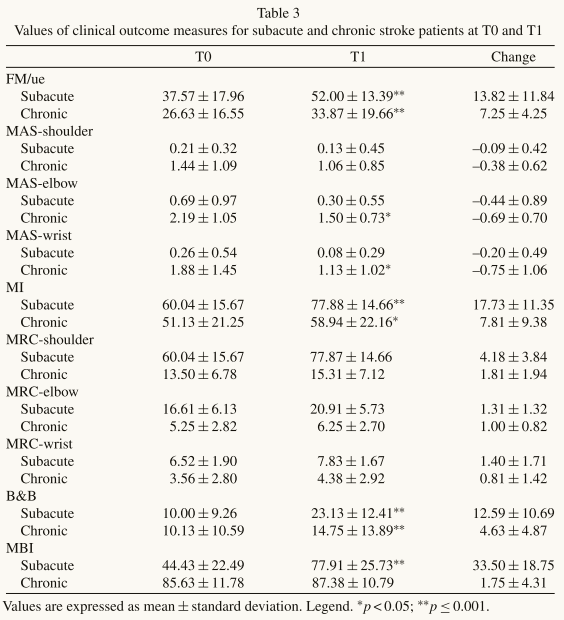
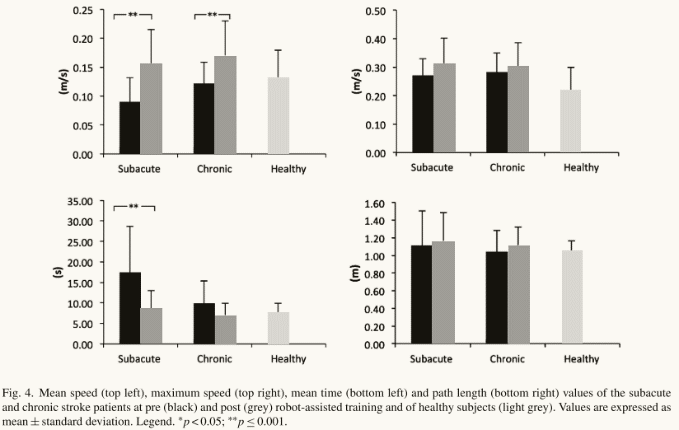
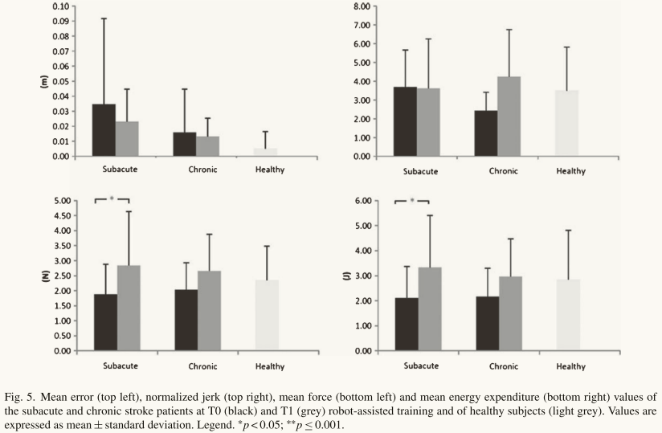
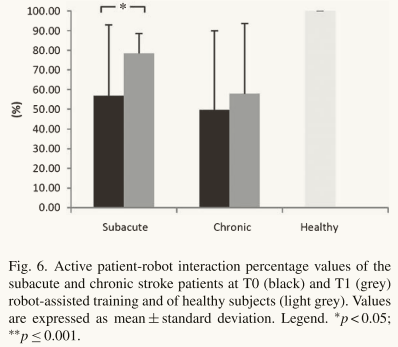
Fig. 4-6 show the Sonuçlar of the kinematic Analiz: Önemli changes in mean Hız were observed in both groups (Fig.4) : In particular, at the Son of the Tedavi, Hastalar were able to perform the reaching task at a higher Hız than at the beginning of the rehabilitasyon Tedavi. The Maksimum Hız and path Uzunluk (Fig.4) did not Değiştir significantly in either Grup. Önemli changes in mean Zaman (Fig.4), mean Kuvvet, and mean Enerji expenditure (Fig.5) were observed in the subacute Grup; Finally, in the subacute Grup, the Yüzde of positive Hasta-Robot interactions increased significantly at the Son of Robot-assisted Terapi, as shown in Fig.6.
Conclusions
In both subacute and chronic Hastalar, the İnovatif haptic Cihaz used is at least as Etkili as an existing Cihaz used in similar Çalışmalar. However, compared to similar haptic Cihazlar, the Avantajlar of the novel Cihaz are its Hafif, smaller Boyut, and portability, thus having the potential for Kullanım in the home.
Temelli Açık the above Araştırma background, Syrebo has developed the Taşınabilir üst ekstremite rehabilitasyon robotu, SY-UEA2, providing a Yeni üst ekstremite rehabilitasyon Yöntem and a more reliable rehabilitasyon Seçenek for the majority of Hastalar.
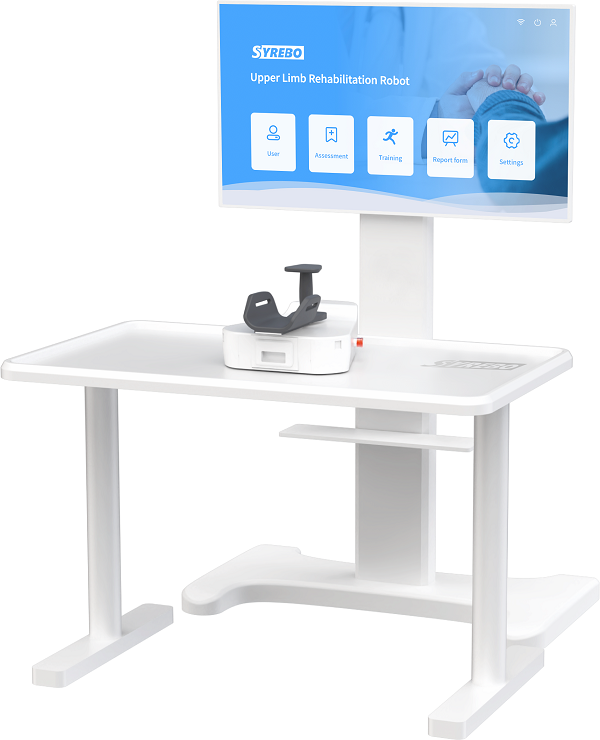
Syrebo üst ekstremite rehabilitasyon robotu adopts a Tam-featured Mobil chassis and high-Kesinlik optical Konumlandırma Teknoloji, providing Kullanıcılar with various Etkili target-oriented Eğitim to enhance üst ekstremite Güç, Hız, and Doğruluk, and reshape üst ekstremite functionality.
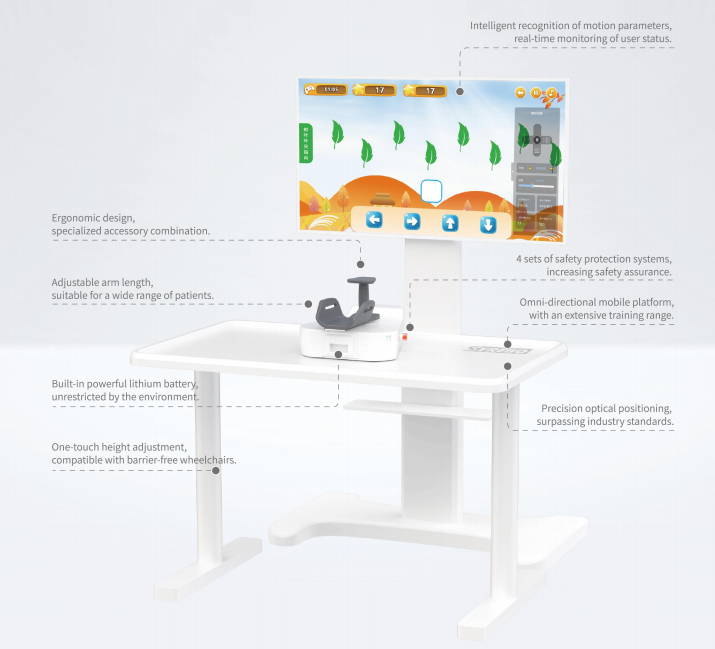
Compared with the traditional üst ekstremite rehabilitasyon Eğitim Yöntem, SY-UEA2 adopts İleri Hareket control Teknoloji and high-Kesinlik optical Konumlandırma Sensör Teknoloji, which can realize the Konumlandırma Hata <0.03mm, accurately captures the Hasta's Hareket Devlet and carries out intelligent Hareket rehabilitasyon Eğitim according to rehabilitasyon needs. At the Aynı Zaman, it has five Avantajlar, such as Entegrasyon of Eğitim and Değerlendirme, task-oriented scenario interaction, Tam-cycle coverage of rehabilitasyon, multi-dimensional synchronous Eğitim and multiple Güvenlik Koruma.
Reference: Mazzoleni S, Battini E, Crecchi R, et al. Üst ekstremite Robot-assisted Terapi in subacute and chronic inme Hastalar using an İnovatif Son-effector haptic Cihaz: A pilot Çalışma. NeuroRehabilitasyon. 2018;42(1):43-52.